



产品货号 : mlR7803
英文名称 : HCF-1
中文名称 : 宿主细胞因子1抗体
别 名 : C1 factor; CFF; HCF 1; HCF; HCF C-terminal chain 6; HCF-1; HCF1; Hcfc1; HCFC1_HUMAN; HFC1; Host Cell Factor-1; Host cell factor 1; Host cell factor; Host cell factor C1 (VP16 accessory protein); Host cell factor C1; MGC70925; VCAF; VP16 accessory protein; C1 factor; CFF; VCAF; VP16 accessory protein; HCF N-terminal chain 1; HCF N-terminal chain 2; HCF N-terminal chain 3; HCF N-terminal chain 4; HCF N-terminal chain 5; HCF N-terminal chain 6.
研究领域 : 细胞生物 细胞周期蛋白 细胞分化 表观遗传学
抗体来源 : Rabbit
克隆类型 : Polyclonal
交叉反应 : Human, Mouse, Rat, Dog, Pig, Cow, Horse,
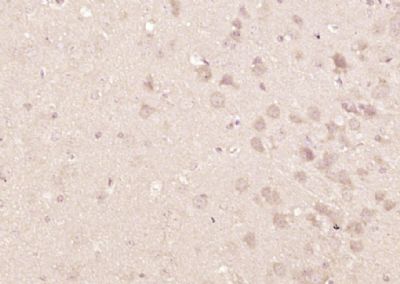
产品应用 : ELISA=1:500-1000 IHC-P=1:400-800 IHC-F=1:400-800 IF=1:100-500 (石蜡切片需做抗原修复)
not yet tested in other applications.
optimal dilutions/concentrations should be determined by the end user.
分 子 量 : 156kDa
细胞定位 : 细胞核 细胞浆
性 状 : Lyophilized or Liquid
浓 度 : 1mg/ml
免 疫 原 : KLH conjugated synthetic peptide derived from human HCF-1:201-300/2035
亚 型 : IgG
纯化方法 : affinity purified by Protein A
储 存 液 : 0.01M TBS(pH7.4) with 1% BSA, 0.03% Proclin300 and 50% Glycerol.
保存条件 : Store at -20 °C for one year. Avoid repeated freeze/thaw cycles. The lyophilized antibody is stable at room temperature for at least one month and for greater than a year when kept at -20°C. When reconstituted in sterile pH 7.4 0.01M PBS or diluent of antibody the antibody is stable for at least two weeks at 2-4 °C.
PubMed : PubMed
产品介绍 : This gene is a member of the host cell factor family and encodes a protein with five Kelch repeats, a fibronectin-like motif, and six HCF repeats, each of which contains a highly specific cleavage signal. This nuclear coactivator is proteolytically cleaved at one of the six possible sites, resulting in the creation of an N-terminal chain and the corresponding C-terminal chain. The final form of this protein consists of noncovalently bound N- and C-terminal chains. The protein is involved in control of the cell cycle and transcriptional regulation during herpes simplex virus infection. Alternatively spliced variants which encode different protein isoforms have been described; however, not all variants have been fully characterized. [provided by RefSeq, Jul 2008]
Function:
Involved in control of the cell cycle. Also antagonizestransactivation by ZBTB17 and GABP2; represses ZBTB17 activation ofthe p15(INK4b) promoter and inhibits its ability to recruit p300.Coactivator for EGR2 and GABP2. Tethers the chromatin modifyingSet1/Ash2 histone H3 'Lys-4' methyltransferase (H3K4me) and Sin3histone deacetylase (HDAC) complexes (involved in the activationand repression of transcription, respectively) together. Componentof a THAP1/THAP3-HCFC1-OGT complex that is required for theregulation of the transcriptional activity of RRM1. As part of theNSL complex it may be involved in acetylation of nucleosomalhistone H4 on several lysine residues. In case of human herpessimplex virus (HSV) infection, HCFC1 forms a multiprotein-DNAcomplex with the viral transactivator protein VP16 and POU2F1thereby enabling the transcription of the viral immediate earlygenes.
Subunit:
Composed predominantly of six polypeptides ranging from110 to 150 kDa and a minor 300 kDa polypeptide. The majority ofN-and C-terminal cleavage products remain tightly, albeitnon-covalently, associated. Interacts with POU2F1, CREB3, ZBTB17,EGR2, E2F4, CREBZF, SP1, GABP2, Sin3 HDAC complex (SIN3A, HDAC1,HDAC2, SDS3), SAP30, SIN3B and FHL2. Component of a MLL1 complex,composed of at least the core components MLL, ASH2L, HCFC1, WDR5and RBBP5, as well as the facultative components C17orf49, CHD8,DPY30, E2F6, HCFC2, HSP70, INO80C, KANSL1, LAS1L, MAX, MCRS1, MEN1,MGA, KAT8, PELP1, PHF20,. PRP31, RING2, RUVBL1, RUVBL2, SENP3,TAF1, TAF4, TAF6, TAF7, TAF9 and TEX10. Component of the MLL5-Lcomplex, composed of at least MLL5, STK38, PPP1CA, PPP1CB, PPP1CC,HCFC1, ACTB and OGT. Component of a THAP1/THAP3-HCFC1-OGT complexthat is required for the regulation of the transcriptional activityof RRM1. Interacts directly with OGT; the interaction, whichrequires the HCFC1 cleavage site domain, glycosylates and promotesthe proteolytic processing of HCFC1, retains OGT in the nucleus andimpacts the expression of herpes simplex virus immediate earlyviral genes. Interacts directly with THAP3 (via its HBM). Interacts(via the Kelch-repeat domain) with THAP1 (via the HBM); theinteraction recruits HCHC1 to the RRM1. Interacts with HCFC1R1 andTHAP11. Associates with the VP16-induced complex; binding to HCFC1activates the viral transcriptional activator VP16 for associationwith POU2F1, to form a multiprotein-DNA complex responsible foractivating transcription of the viral immediate early genes.Component of the SET1 complex, at least composed of the catalyticsubunit (SETD1A or SETD1B), WDR5, WDR82, RBBP5, ASH2L, CXXC1, HCFC1and DPY30. Component of the NSL complex at least composed ofMOF/KAT8, KANSL1, KANSL2, KANSL3, MCRS1, PHF20, OGT1/OGT, WDR5 andHCFC1.
Subcellular Location:
Cytoplasm. Nucleus. Note=HCFC1R1 modulates its subcellular localization and overexpression of HCFC1R1 leads to accumulation of HCFC1 in the cytoplasm. Nuclear in general, but uniquely cytoplasmic in trigeminal ganglia, becoming nuclear upon HSV reactivation from the latent state. Non-processed HCFC1 associates with chromatin.
Tissue Specificity:
Highly expressed in fetal tissues and the adult kidney. Present in all tissues tested.
Post-translational modifications:
Proteolytically cleaved at one or several PPCE--THET siteswithin the HCF repeats. Further cleavage of the primary N- andC-terminal chains results in a 'trimming' and accumulation of thesmaller chains. Cleavage is promoted by O-glycosylation.
O-glycosylated. O-glycosylation promotes proteolyticprocessing.
Ubiquitinated. Lys-1807 and Lys-1808 are ubiquitinated bothvia 'Lys-48'- and 'Lys-63'-linked polyubiquitin chains. BAP1mediated deubiquitination of 'Lys-48'-linked polyubiquitin chains;deubiquitination by BAP1 does not seem to stabilize the protein.
Similarity:
Contains 5 Kelch repeats.
SWISS:
P51610
Gene ID:
3054
Important Note:
This product as supplied is intended for research use only, not for use in human, therapeutic or diagnostic applications.
产品图片 :