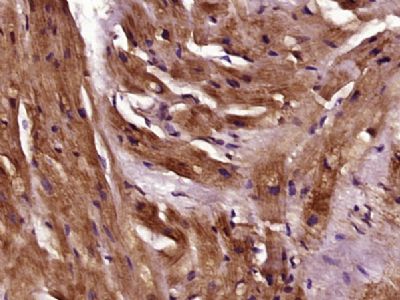





产品货号 : mlR9622
英文名称 : Tropomyosin
中文名称 : 原肌球蛋白1抗体
别 名 : Tropomyosin 1 (alpha); Alpha tropomyosin; Alpha-tropomyosin; C15orf13; cardiomyopathy, hypertrophic 3; CMD1Y; CMH3; HTM alpha; sarcomeric tropomyosin kappa; TMSA; TPM1; TPM1_HUMAN; Tropomyosin 1; Tropomyosin1; Tropomyosin alpha 1 chain; Tropomyosin alpha-1 chain; Tropomyosin-1; Tropomyosin α; Tropomyosin-α; Tropomyosinα.
研究领域 : 心血管 信号转导 细胞骨架 细胞外基质
抗体来源 : Rabbit
克隆类型 : Polyclonal
交叉反应 : Human, Mouse, Rat, Dog, Zebrafish, Sheep,
产品应用 : ELISA=1:500-1000 IHC-P=1:400-800 IHC-F=1:400-800 ICC=1:100-500 IF=1:100-500 (石蜡切片需做抗原修复)
not yet tested in other applications.
optimal dilutions/concentrations should be determined by the end user.
分 子 量 : 33kDa
细胞定位 : 细胞浆
性 状 : Lyophilized or Liquid
浓 度 : 1mg/ml
免 疫 原 : KLH conjugated synthetic peptide derived from human Tropomyosin:201-284/284
亚 型 : IgG
纯化方法 : affinity purified by Protein A
储 存 液 : 0.01M TBS(pH7.4) with 1% BSA, 0.03% Proclin300 and 50% Glycerol.
保存条件 : Store at -20 °C for one year. Avoid repeated freeze/thaw cycles. The lyophilized antibody is stable at room temperature for at least one month and for greater than a year when kept at -20°C. When reconstituted in sterile pH 7.4 0.01M PBS or diluent of antibody the antibody is stable for at least two weeks at 2-4 °C.
PubMed : PubMed
产品介绍 : Binds to actin filaments in muscle and non-muscle cells. Plays a central role, in association with the troponin complex, in the calcium dependent regulation of vertebrate striated muscle contraction. Smooth muscle contraction is regulated by interaction with caldesmon. In non-muscle cells is implicated in stabilizing cytoskeleton actin filaments.
Function:
Binds to actin filaments in muscle and non-muscle cells. Plays a central role, in association with the troponin complex, in the calcium dependent regulation of vertebrate striated muscle contraction. Smooth muscle contraction is regulated by interaction with caldesmon. In non-muscle cells is implicated in stabilizing cytoskeleton actin filaments.
Subunit:
Heterodimer of an alpha and a beta chain (By similarity). Interacts with HRG (via the HRR domain); the interaction contributes to the antiangiogenic properties of the histidine/proline-rich region (HRR) of HRG.
Subcellular Location:
Cytoplasm, cytoskeleton.
Tissue Specificity:
Detected in primary breast cancer tissues but undetectable in normal breast tissues in Sudanese patients. Isoform 1 is expressed in adult and fetal skeletal muscle and cardiac tissues, with higher expression levels in the cardiac tissues. Isoform 10 is expressed in adult and fetal cardiac tissues, but not in skeletal muscle.
Post-translational modifications:
Phosphorylated at Ser-283 by DAPK1 in response to oxidative stress and this phosphorylation enhances stress fiber formation in endothelial cells.
DISEASE:
Defects in TPM1 are the cause of familial hypertrophic cardiomyopathy type 3 (CMH3) [MIM:115196]. Familial hypertrophic cardiomyopathy is a hereditary heart disorder characterized by ventricular hypertrophy, which is usually asymmetric and often involves the interventricular septum. The symptoms include dyspnea, syncope, collapse, palpitations, and chest pain. They can be readily provoked by exercise. The disorder has inter- and intrafamilial variability ranging from benign to malignant forms with high risk of cardiac failure and sudden cardiac death.
Defects in TPM1 are the cause of cardiomyopathy dilated type 1Y (CMD1Y) [MIM:611878]. Dilated cardiomyopathy is a disorder characterized by ventricular dilation and impaired systolic function, resulting in congestive heart failure and arrhythmia. Patients are at risk of premature death.
Similarity:
Belongs to the tropomyosin family.
SWISS:
P09493
Gene ID:
7168
Important Note:
This product as supplied is intended for research use only, not for use in human, therapeutic or diagnostic applications.
产品图片